
Holiday Let Accessibility: How Making Your Property More Inclusive Can Fill More Dates

James Druce
Founder, Full Bed Hosts · MSc Tourism Management
Around 16 million disabled people live in the UK, and they take holidays with partners, families, friends and carers. Yet accessible accommodation remains chronically undersupplied, particularly in rural and coastal areas such as Dorset and the New Forest.
Owners who address accessibility, even partially, can serve a market with limited choice and strong loyalty. The aim is not to label every property wheelchair accessible. It is to improve what can reasonably be changed and describe the property so accurately that guests can decide whether it works for their own needs.
The accessibility gap in holiday letting
Most holiday let listings say little or nothing about accessibility. A gallery may show an entrance but crop out the step. “Ground floor accommodation” may still involve a steep path, narrow doorway or shower over a bath.
Guests with accessibility needs can spend hours studying photographs, sending questions and waiting for measurements. Vague assurances such as “should be fine” are not useful when the wrong answer could make a holiday impossible.
A listing that is clear and specific about what the property offers, and what it does not, is immediately valuable. Measurements, photographs and factual descriptions reduce uncertainty. Honesty builds trust even where the property is only suitable for some needs.
This clarity benefits everyone. Parents with pushchairs, guests recovering from surgery and older visitors may all value the same step-free route, good lighting and ground-floor facilities.
Basic improvements with high impact
Level or properly ramped access into the property can remove the first and most obvious barrier. A permanent ramp must be designed safely, with appropriate gradient, width, landings and edge protection. Portable ramps should only be used where a competent assessment confirms they are suitable.
A ground-floor bedroom helps guests who cannot manage stairs, including many who do not use a wheelchair. It becomes more useful when a WC or bathroom is on the same level and the route between rooms is clear.
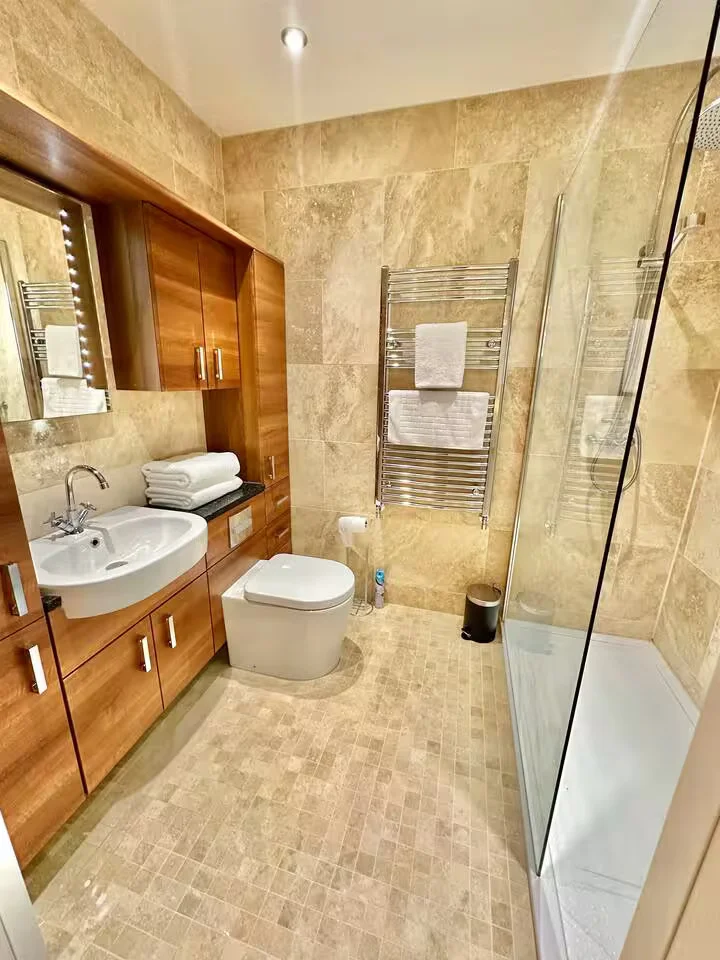
A walk-in or level-access shower can transform suitability. Consider the entrance lip, available turning space, non-slip surface, controls and whether a secure shower seat can be provided. Grab rails in the shower, beside the WC and at key changes of level offer support when positioned professionally.
Wide doorways matter for wheelchair users. Around 85 centimetres clear opening is a useful aspiration, although individual chairs and manoeuvring space differ. Measure the actual clear width rather than quoting the door leaf size.
Good lighting, contrasting switches, easy-to-use handles and uncluttered routes are relatively modest changes with broad benefit. Any structural or bathroom adaptation should be designed with qualified access, building and safety advice.
The listing is the first accessibility improvement
A property does not need to be fully adapted before it can serve guests better. It does need an accurate access description. Begin at the parking space and describe the complete route to the main rooms.
Is there a step at the entrance? State its height and show it in a photograph. If the bedroom is on the ground floor, explain whether the bathroom is too. Give doorway widths, corridor pinch points and the space beside the bed.
Describe paths as level, sloping, paved, gravelled or uneven. Explain how close parking is to the front door and whether unloading can happen nearer than the long-term space. Mention handrails, thresholds and internal steps, including a single step that may otherwise be overlooked.
Do not use “wheelchair friendly” as a broad marketing phrase without evidence. Different guests need different features. Provide facts and invite specific questions so the guest, carer or occupational professional can assess suitability.
Keep this information consistent across Airbnb, Booking.com, direct websites and pre-arrival guides. A detail hidden in one channel can still lead to a failed stay.
Who are you serving?
Accessibility is not one market with one checklist. Some guests use wheelchairs full time and need step-free routes, turning space and adapted washing facilities. Others are partially ambulant or use sticks, crutches or a walking frame.
Older guests may manage a few steps but need a ground-floor bedroom, supportive seating and a shower rather than a bath. They often travel outside school holidays, creating valuable midweek and shoulder-season demand.
Families may include one person with specific mobility, sensory or medical needs while every other guest wants an ordinary family holiday. Accommodation that works for the whole group is particularly scarce.
Carers travelling with a guest may need a separate bedroom, adjacent room or enough space to assist safely. Clear layouts and floor plans help them understand whether support can be provided with dignity.
Ask rather than assume. A guest is the expert in their own requirements. Staff should answer factual questions promptly without promising suitability they cannot confirm.
Reach guests through dedicated platforms
Disabled Holidays and other specialist platforms cater specifically to guests seeking accessible accommodation. Listing there alongside mainstream channels can introduce the property to a market many Dorset owners overlook completely.
Specialist platforms may request detailed access information, measurements and photographs. Treat that process as useful discipline rather than paperwork. The same content can strengthen the direct website and reduce repetitive enquiries.
Only select filters the property genuinely meets. An inaccurate accessibility claim can cause far more harm than leaving a feature unticked. When improvements are made, update every channel and replace old photographs promptly.
Our approach
When Full Bed Hosts onboards a property, we assess which accessibility details belong in the listing and how to present them accurately. We look at arrival, parking, steps, room location and the information guests need before booking.
This is a small part of our holiday let management service, but it makes a significant difference to guest trust. Better information can open more dates without overpromising, while thoughtful physical improvements make the property usable for a wider range of people.